

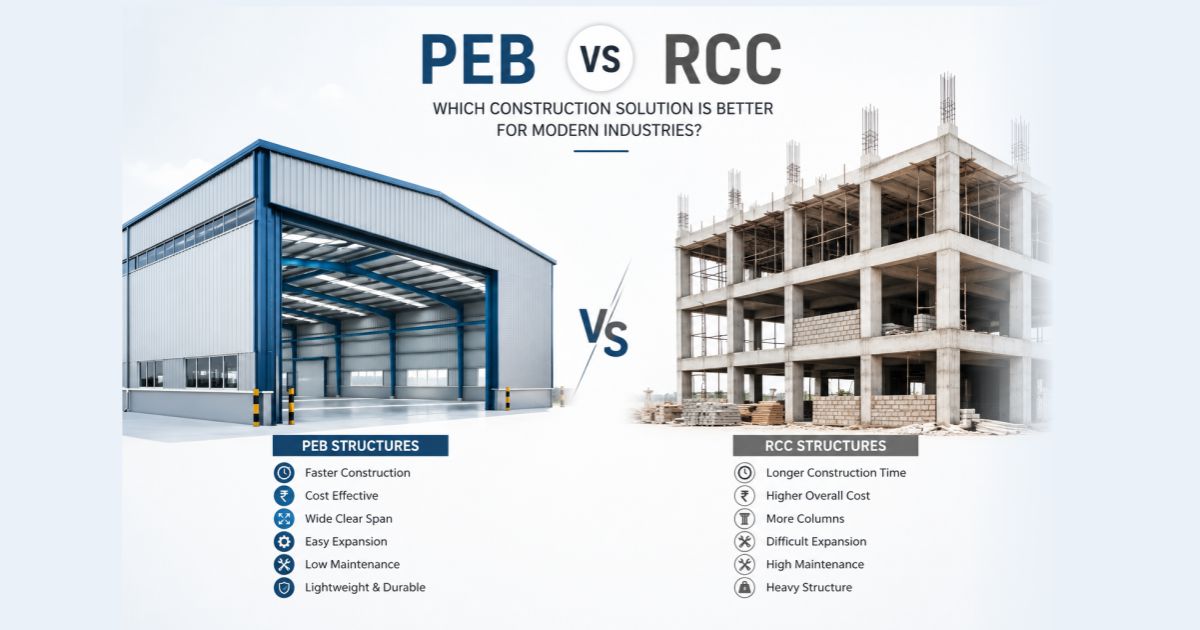
PEB vs RCC Structures: Which Construction Solution is Better for Modern Industries?
Industrial construction has changed rapidly over the last few years. Businesses today want faster project completion, better operational space, lower maintenance, and long-term cost efficiency. Because of this, many industries are now comparing PEB structures with traditional RCC construction before starting a project. Both construction methods have their advantages, but modern industrial development is increasingly moving toward Pre-Engineered Buildings (PEB) because of their speed, flexibility, and efficiency.
Understanding RCC Structures
RCC (Reinforced Cement Concrete) construction has been widely used for decades in residential and commercial projects. It offers strong concrete structures and long-lasting performance.
However, RCC construction usually involves:
- Longer project timelines
- Heavy structural weight
- More on-site labor
- Higher material handling
- Difficult future expansion
For large industrial projects, these factors can increase overall project costs and delays.
Why PEB Structures Are Becoming Popular
PEB structures are manufactured using precision-engineered steel components that are fabricated in factories and assembled at the project site.
This modern construction method provides several advantages for industrial applications such as:
- Warehouses
- Manufacturing units
- Industrial sheds
- Logistics centers
- Commercial buildings
Faster Construction Process
One of the biggest reasons industries prefer PEB structures is faster construction speed. Since most components are pre-manufactured, site installation becomes quicker and more organized. Businesses can begin operations much earlier compared to RCC projects. For industries, saving time often means saving money.
Better Space Utilisation
PEB buildings are designed with large clear spans and fewer internal columns. This creates more usable floor space for:
- Machinery setup
- Storage systems
- Material movement
- Production operations
RCC structures may require more columns, which can limit operational flexibility.
Lower Maintenance and Future Flexibility
PEB structures are easier to expand in the future. Additional sections can be added with minimal disruption to existing operations. Modern steel structures also require lower maintenance when proper coating systems are used. This makes PEB construction more practical for growing industries.
Which One is Better for Modern Industries?
For residential projects, RCC construction may still remain common. But for industrial infrastructure, warehouses, logistics parks, and factory buildings, PEB structures are becoming the preferred choice because they offer:
- Faster execution
- Better flexibility
- Cost efficiency
- Modern industrial design
- Easier scalability
Conclusion
Both RCC and PEB structures have their importance, but modern industrial businesses are increasingly choosing PEB construction for its speed, efficiency, and operational advantages. For businesses planning industrial construction projects in Raipur and Chhattisgarh, Tamim Industries provides dependable industrial construction and PEB solutions tailored for long-term performance and business growth.