

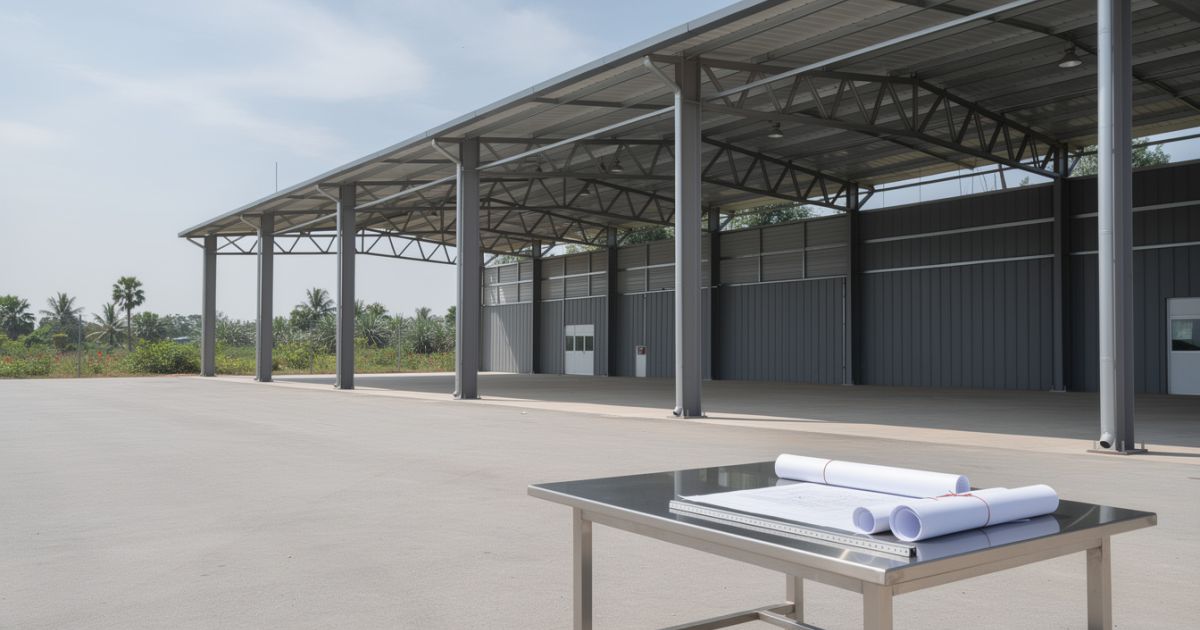
How to Choose the Right PEB Manufacturer for Your Industrial Building in Chhattisgarh
Planning an industrial building requires more than selecting a suitable plot and construction material. The structure needs to support the operational requirements of the business while meeting engineering, safety, durability, and future expansion needs.
For warehouses, factories, workshops, and industrial sheds, Pre-Engineered Buildings (PEB) have become a practical construction option. However, the performance of a PEB structure depends greatly on the manufacturer and construction partner you choose.
If you are planning an industrial project in Raipur, Bilaspur, Raigarh, Korba, Bhilai, or other parts of Chhattisgarh, here are some important factors to consider when selecting a PEB manufacturer.
1. Understand Your Project Requirements First
Before approaching a PEB manufacturer, clearly define how the building will be used.
For example, a warehouse may require large storage areas and vehicle access, while a manufacturing facility may require greater building height, ventilation, crane provisions, machinery space, or specialized flooring.
Important requirements may include:
-
Building length and width
-
Required height
-
Clear span
-
Number and size of entrances
-
Crane requirements
-
Storage requirements
-
Ventilation
-
Natural lighting
-
Insulation
-
Future expansion
-
Location and site conditions
A manufacturer should be able to understand these requirements and develop a suitable structural solution.
2. Check Engineering and Design Capabilities
PEB is not simply about fabricating steel members and assembling them at the site.
Proper engineering is an important part of the process. The building needs to be designed according to its intended use, dimensions, loads, environmental conditions, and applicable construction requirements.
Ask the manufacturer about their engineering process and how the structural design is developed for each project.
A manufacturer with appropriate engineering support can help identify structural requirements before fabrication begins.
3. Evaluate Fabrication Quality
The fabrication stage directly affects the quality and installation of the final structure.
Important factors include:
-
Cutting accuracy
-
Welding quality
-
Connection details
-
Surface preparation
-
Painting or protective coating
-
Quality control
-
Dimensional accuracy
-
Material traceability
A professional fabrication process helps ensure that structural components are manufactured according to the approved design.
4. Consider the Type of Industrial Building
Not every industrial building has the same requirements.
A PEB manufacturer should ideally understand different applications such as:
Warehouses
Warehouses generally require efficient storage space, large entrances, appropriate clear height, and easy movement of goods.
Manufacturing Facilities
Factories may require additional height, machinery space, ventilation, crane systems, and customized layouts.
Industrial Sheds
Industrial sheds can be designed for workshops, storage, fabrication, production, and other operational requirements.
Cold Storage Facilities
Cold storage projects require special consideration for insulation, temperature control, building envelope, and internal operational requirements.
Discussing the exact application with the manufacturer helps ensure that the building is designed around its intended purpose.
5. Look at Project Execution Capability
A PEB project involves more than manufacturing.
The overall process may include:
-
Site assessment
-
Structural design
-
Engineering drawings
-
Material procurement
-
Component fabrication
-
Transportation
-
Foundation coordination
-
Erection and installation
-
Roofing and cladding
-
Final inspection
A manufacturer capable of coordinating different stages can help reduce communication gaps between fabrication and site execution.
6. Consider Location and Site Conditions
Chhattisgarh has a growing industrial and manufacturing base, with projects spread across cities and industrial areas.
The site location can affect transportation, erection planning, material movement, and project scheduling.
For projects in Raipur, Bilaspur, Raigarh, Korba, Bhilai, and nearby industrial areas, working with a manufacturer familiar with regional project conditions can make coordination easier.
7. Ask About Customization
A good industrial building should be designed around the business rather than forcing the business to adapt to a standard structure.
Depending on the project, customization may include:
-
Building dimensions
-
Roof design
-
Wall cladding
-
Doors and shutters
-
Ventilation systems
-
Skylights
-
Insulation
-
Mezzanine floors
-
Crane provisions
-
Future expansion requirements
Discuss these requirements before finalizing the design.
8. Compare More Than Just the Initial Price
Cost is an important part of any industrial construction project, but comparing manufacturers only on the initial quotation can make it difficult to understand the actual value of the project.
When comparing quotations, consider:
-
Structural specifications
-
Steel quality
-
Engineering and design
-
Fabrication standards
-
Roofing and cladding specifications
-
Painting or coating system
-
Transportation
-
Erection and installation
-
Project timelines
-
Warranty and after-sales support
A detailed comparison can provide a clearer understanding of what is included in each proposal.
9. Discuss Future Expansion
Industrial businesses often grow over time. If additional production, storage, or operational space may be required in the future, discuss this with the manufacturer during the initial design stage.
Future expansion may influence the building layout, structural design, column positioning, and site planning.
Considering expansion early can prevent unnecessary complications later.
10. Choose a Manufacturer That Understands Industrial Construction
A PEB manufacturer should understand that an industrial building is not simply a steel structure. It is part of a larger business operation.
The building needs to support movement of materials, equipment installation, employee access, storage, production, transportation, maintenance, and future growth.
For this reason, businesses should evaluate a manufacturer's engineering knowledge, fabrication capability, project experience, quality processes, and ability to execute projects according to specific requirements.
Tamim Industries for PEB and Industrial Construction
Tamim Industries, based in Raipur, Chhattisgarh, provides solutions for PEB buildings, conventional sheds, industrial fabrication, and civil construction.
With a focus on industrial and construction requirements, the company works on projects where structural design, fabrication, and practical site requirements need to work together.
For businesses planning a warehouse, factory, industrial shed, or other structural project in Chhattisgarh and nearby regions, discussing the project requirements with an experienced construction partner can help establish the right approach from the beginning.
Conclusion
Selecting a PEB manufacturer is an important decision because the manufacturer can influence the design, fabrication quality, project coordination, and overall execution of the structure.
Before finalizing a company, evaluate its engineering capabilities, fabrication process, project experience, material specifications, installation support, and ability to customize the building according to your requirements.
A properly planned PEB project can provide a practical and adaptable structure for industrial operations while supporting the current and future needs of the business.