

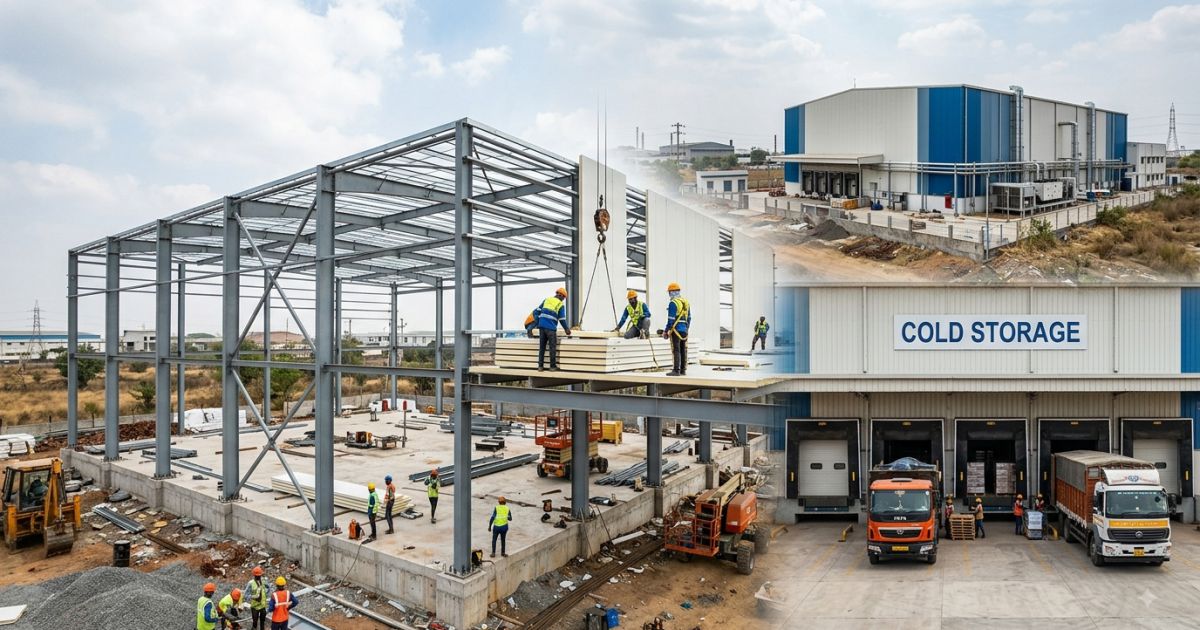
How to Claim Chhattisgarh Industrial Policy (2024–2030) Subsidies for Cold Storage Construction
Setting up a cold storage facility requires significant investment in land, building construction, insulation, refrigeration systems, electrical infrastructure, storage equipment, and material-handling facilities. For businesses planning a new cold storage project in Chhattisgarh, government incentives can potentially reduce the overall investment burden.
The Chhattisgarh Industrial Development Policy 2024–30 specifically provides that cold storages, warehouses, and logistics hubs established on industrial or commercial land can be eligible for subsidies, exemptions, and concessions under the Industrial Investment Incentive scheme.
However, receiving an incentive is not automatic. The project and enterprise must satisfy the applicable eligibility conditions and follow the prescribed registration, approval, production-certification, and claim process.
This guide explains the basic process for businesses planning cold storage construction in Chhattisgarh.
What Does the Chhattisgarh Industrial Policy 2024–30 Offer?
The Industrial Development Policy 2024–30 is designed to encourage new investment, expansion, diversification, substitution, and modernization of eligible enterprises in Chhattisgarh.
The policy is effective from 1 November 2024 to 31 March 2030. It classifies development blocks into Groups 1, 2, and 3, and the level of incentives can vary depending on the location and category of the enterprise.
For cold storage projects, the important point is that the policy explicitly includes cold storages among the facilities that may receive benefits under the Industrial Investment Incentive provisions.
Are Cold Storage Buildings Eligible for Subsidy?
Potentially, yes.
The policy states that warehouses, logistics hubs, and cold storages established on industrial/commercial land in Chhattisgarh are eligible for subsidies, exemptions and benefits as specified under the Industrial Investment Incentive scheme.
This does not mean that every cold storage automatically receives the same percentage of subsidy.
The actual benefit depends on factors such as:
-
Enterprise category
-
Project location
-
Development block
-
General or thrust sector classification
-
Fixed Capital Investment
-
New or existing enterprise status
-
Applicable policy conditions
-
Required registrations and certificates
Therefore, businesses should calculate the incentive based on their actual project details rather than relying on a generic subsidy percentage.
What Counts as Fixed Capital Investment?
One important factor is the project's Fixed Capital Investment (FCI).
Under the policy, FCI can include investment related to:
-
Land and land development
-
Shed or building construction
-
New plant and machinery
-
Electricity supply
-
Water supply
-
Boundary wall construction
The policy specifically includes shed/building construction within the definition of Fixed Capital Investment.
This is particularly relevant for cold storage projects because construction of the building itself can represent a significant portion of the overall investment.
Step 1: Decide the Project Structure and Location
Before applying for incentives, the investor should establish the basic project details.
These include:
-
Proposed cold storage location
-
District and development block
-
Land ownership or lease
-
Proposed storage capacity
-
Building area
-
Estimated project investment
-
Refrigeration requirements
-
Plant and machinery
-
Expected employment
-
Proposed date of commercial operation
Location matters because Chhattisgarh's policy categorizes development blocks into different groups, and incentive levels can vary by group.
For example, the policy's current classification lists different blocks of Raipur, Bilaspur, Durg, Korba, and other districts under Group 1, Group 2, or Group 3.
Step 2: Register Through Chhattisgarh's Single Window System
The Chhattisgarh government provides the One Click Single Window System for investors.
The official process includes:
-
Entity registration and account activation
-
Udyam Akanksha
-
Departmental subsidies
-
Application tracking
-
Certificate generation
-
Subsidy disbursement
This makes the One Click system an important starting point for businesses planning to claim incentives under the Industrial Development Policy.
Step 3: Obtain Udyam Akanksha
The policy requires eligible enterprises to avail Udyam Akanksha.
The policy also states that, after starting production, obtaining a production certificate from the competent authority is mandatory for determining eligibility under the industrial investment promotion provisions.
Therefore, investors should complete the required registration and project documentation before making major project decisions.
Step 4: Establish the Cold Storage Facility
After the required approvals and project formalities, construction and installation can proceed according to the approved project plan.
A cold storage project may include:
Building Construction
-
Site development
-
Foundation
-
RCC work
-
Structural steel or PEB structure
-
Roofing
-
Wall systems
-
Loading platforms
-
Drainage
Cold Storage Infrastructure
-
Insulated panels
-
Insulated flooring
-
Cold rooms
-
Refrigeration equipment
-
Electrical systems
-
Temperature monitoring
-
Material-handling systems
Supporting Facilities
-
Office
-
Staff areas
-
Parking
-
Truck movement area
-
Loading and unloading zone
-
Utility area
For the building component, working with an experienced industrial construction company can help coordinate civil construction, structural steel, PEB work, flooring, and other building requirements.
Step 5: Obtain the Production/Commercial Operation Certificate
The policy defines a new enterprise as one whose commercial production or service commencement falls within the policy period and which possesses the required certificate of commencement issued by the competent authority.
The One Click system also identifies the Production Certificate as the certificate used to certify commencement of commercial production for accessing incentives.
This makes the production certificate an important part of the incentive process.
Step 6: Apply for the Applicable Incentives
Once the project satisfies the applicable conditions, the investor can apply for the relevant departmental subsidies through the Single Window System.
The government portal's stated workflow is:
Registration → Udyam Akanksha → Departmental Subsidies → Application Tracking → Certificate Generation → Subsidy Disbursement.
The exact documents and claim requirements can vary depending on the incentive being claimed.
What Subsidies Can a Cold Storage Project Potentially Receive?
The applicable benefits depend on how the cold storage enterprise is classified under the policy.
For eligible MSMEs, the policy provides options including Net SGST reimbursement or Fixed Capital Investment subsidy, along with other possible incentives such as interest subsidy, electricity-duty exemption, stamp-duty exemption, land-diversion concessions, project-report subsidy, and certain certification-related reimbursements.
For example, under the MSME package, eligible enterprises can choose between Net SGST reimbursement and FCI subsidy, subject to the applicable conditions and limits. The FCI subsidy percentage and maximum amount vary according to enterprise size, development-block group, and whether the enterprise is classified as general or thrust sector.
Important: These figures should not be treated as a guaranteed cold-storage subsidy. The investor's actual eligibility must be determined using the current policy provisions and project details.
Use the Official Subsidy Calculator
Instead of estimating incentives manually, investors can use the official Chhattisgarh Subsidy Calculator.
The calculator allows users to enter details such as:
-
Business category
-
Industry type
-
Sector
-
Plant and machinery investment
-
Fixed Capital Investment
-
District
-
Development block
-
Land area
-
Loan amount
-
Interest rate
-
Electricity usage
-
Employment
-
Export status
It then provides a policy-based calculation of eligible incentives.
This is particularly useful when preparing a preliminary financial plan for a proposed cold storage facility.
Documents and Information to Keep Ready
Although the exact documentation depends on the incentive and project, investors should maintain proper records of the project from the beginning.
Important documents may include:
-
Business registration documents
-
PAN and GST details
-
Udyam registration, where applicable
-
Udyam Akanksha
-
Land ownership/lease documents
-
Building and project approvals
-
Project report
-
Detailed project cost
-
Invoices and payment records
-
Plant and machinery invoices
-
Construction expenditure records
-
Bank/loan documents
-
Employment records
-
Production/commercial operation certificate
-
Applicable statutory approvals
Keeping construction and equipment expenditure properly documented is especially important when claiming incentives linked to Fixed Capital Investment.
Why Project Documentation Matters
Cold storage projects involve substantial investment across several categories.
For example, the project may have separate expenditure for:
-
Land
-
Civil construction
-
PEB or structural steel
-
Insulation
-
Refrigeration
-
Electrical systems
-
Flooring
-
Machinery
-
Storage equipment
Proper accounting and documentation can make it easier to establish eligible investment when submitting incentive claims.
Investors should therefore maintain invoices, payment records, contracts, certificates, and other supporting documents throughout the project rather than attempting to reconstruct them after completion.
Can Cold Storage Construction Cost Be Included?
Building construction is specifically included within the policy's definition of Fixed Capital Investment.
This can make the construction component particularly relevant when planning a cold storage investment.
However, investors should distinguish between eligible building investment and other project costs. Not every expense connected with a cold storage facility should automatically be assumed to qualify.
The final eligibility should be determined according to the applicable policy, rules, notifications, and departmental assessment.
Why Choose an Experienced Cold Storage Building Contractor?
Government incentives are only one part of a successful cold storage project. The facility itself needs to be properly designed and constructed according to its operational requirements.
A suitable construction partner can help with:
-
Site development
-
Foundation construction
-
PEB structures
-
Conventional steel structures
-
Industrial flooring
-
Loading platforms
-
Structural fabrication
-
Warehouse construction
-
Civil construction
-
Turnkey project execution
The building should also be coordinated with insulation, refrigeration, electrical, fire-safety, and other specialist systems.
Cold Storage Construction in Chhattisgarh
Chhattisgarh's Industrial Development Policy provides a favorable framework for investment in cold storage, warehousing, logistics, food processing, and other sectors. The state also identifies Agro & Food Processing as one of its focus sectors.
For investors, this creates an opportunity to evaluate cold storage not only as a storage facility but as part of a broader agricultural and food-processing supply chain.
A properly planned facility can support activities such as agricultural storage, food distribution, processing, and temperature-controlled logistics.
Common Mistakes to Avoid
Assuming Every Project Gets the Same Subsidy
Incentives vary according to eligibility, enterprise category, location, and applicable policy provisions.
Starting Without Understanding the Policy
Investors should understand registration and incentive requirements before making major investment decisions.
Poor Documentation
Missing invoices, approvals, payment records, or certificates can create problems during the claim process.
Ignoring the Development Block
The development-block category can affect the level of applicable incentives.
Treating Construction and Refrigeration as the Same Scope
Cold storage construction and refrigeration are connected but technically different areas. Building construction should be properly coordinated with the refrigeration system designer and equipment supplier.
Conclusion
The Chhattisgarh Industrial Development Policy 2024–30 provides an opportunity for eligible cold storage projects to access industrial investment incentives. The policy specifically recognizes cold storages established on industrial or commercial land as eligible for applicable subsidies, exemptions, and concessions.
However, the amount and type of benefit depend on the project's specific circumstances. Businesses should therefore avoid relying on a fixed subsidy percentage and instead evaluate their project using the official policy and subsidy calculator.
The basic process is:
Plan the project → Select the location → Register through One Click → Complete Udyam Akanksha → Establish the facility → Obtain the production certificate → Apply for eligible incentives → Track the application → Receive approved subsidy.
For investors planning a cold storage facility in Chhattisgarh, proper construction planning and incentive planning should go hand in hand.
Tamim Industries provides civil construction, PEB, conventional steel structures, structural fabrication, warehouse construction, and turnkey industrial construction solutions for industrial projects.
Planning a cold storage project in Chhattisgarh? Contact Tamim Industries to discuss your building and construction requirements.
Important Disclaimer
Government policies, eligibility conditions, procedures, and incentive limits can be amended or updated. This article is for general information and should not be treated as financial, legal, or government-authorized advice. Before making an investment or submitting a subsidy claim, verify the current provisions with the Government of Chhattisgarh and the concerned department.